
Best-Selling Program
Golden Gate University
DBA in Generative AI
Golden Gate University Generative AI programs are designed for professionals who want to learn modern AI skills, gain real-world insights, and grow in their career—without disturbing their current job or business commitments.
- Eligibility: Graduate/ Post-Graduate
- Admission Deadline: 31st-Mar-2026
- Location: San Francisco, California
- Designed for: Working Professionals & Entrepreneurs
Admission Open
Academic Experts will assist you!
About Golden Gate University San Francisco
Golden Gate University was established in 1901 by Robert A. Thompson with a clear goal to offer practical and career-focused education for working professionals. Based in San Francisco, the university is well known for its flexible online learning model, industry-relevant curriculum, and experienced faculty members.
Career Advancement Opportunities
Graduates develop practical business, AI, and leadership skills that support promotions, career switches, and senior-level responsibilities in their organization.
Global Career Relevance
The industry-aligned Generative AI curriculum prepares learners for roles in multinational companies, global tech firms, and international business environments.
Higher Earning Potential
Advanced AI and business qualifications often help professionals improve salary prospects and achieve long-term career growth across multiple industries.

- 3 Years Program Duration
- Globally Recognized Top-Ranked Online DBA Program
- No entrance exam Like GRE/GMAT/TOEFL
- WES Accredited
-
U.S.
Accredited University -
Globally Recognized
Top-Ranked Online DBA/MBAProgram -
2500+
Global CXOs -
10k+
Professionals Enrolled
Accreditation & Collaboration
Golden Gate University, San Francisco

WASC
Ensures recognized academic quality and institutional standards.

Association of American Law Schools
Reflects excellence in legal education and faculty standards.

State Bar Of California
Confirms compliance with professional legal education norms.

AACSB Member
Rushford is a member of AACSB, advancing global quality in business education.
Your Transformative Journey to the Doctorate Degree
Start Your DBA Journey
- Begin your transformative path to leadership.
Complete Your Concentration courses
- Fundamentals of Machine Learning & AI
- Deep Learning & Its Variants
- Deploying Generative AI Using Pre-trained Models
- Using AI Ethically & Responsibly
- AI Project Design and Execution
Dissertation Phase
- Research Topic Selection
- Literature Review
- Research Design
- Data Collection & Analysis
- Draft Dissertation
Complete Your Research Foundation Courses
- Doctoral Research Methods and Analysis
- Emerging Digital Technologies
Final Dissertation Defense
- Present and Defend Your Dissertation
Collect Your Doctorate Degree
- Achieve your DBA title and make a global impact
Your Transformative Journey to the Doctorate Degree
Start Your DBA Journey
- Begin your transformative path to leadership.
Complete Your Research Foundation Courses
- Doctoral Research Methods and Analysis
- Emerging Digital Technologies
Final Dissertation Defense
- Present and Defend Your Dissertation

Complete Your Concentration courses
- Fundamentals of Machine Learning & AI
- Deep Learning & Its Variants
- Deploying Generative AI Using Pre-trained Models
- AI Project Design and Execution
Dissertation Phase
- Research Topic Selection
- Literature Review
- Research Design
- Data Collection & Analysis
- Draft Dissertation
Collect Your Doctorate Degree
- Achieve your DBA title and make a global impact
GGU DBA in Emerging Technologies Syllabus
- These courses provide the foundational knowledge and applied skills necessary to understand, evaluate, and implement emerging technologies in complex business environments.
Course Objective
- This course provides a comprehensive introduction to core concepts in artificial intelligence and machine learning, with a focus on strategic business applications. It addresses foundational algorithms, modeling techniques, and data-driven decision frameworks, while examining how these technologies can be leveraged to enhance operational efficiency, drive innovation, and address complex organizational challenges. Emphasis is placed on the role of machine learning in evidence-based management and predictive analytics.
- Learn the fundamentals of machine learning, from regression to ensemble models, and uncover patterns through classification, clustering, and rule mining. Master data-driven decision-making with visualization, storytelling, and no-code AI tools.
- Topics Covered: Data-Driven Strategy through Statistical Modeling and Regression, Business Applications of Classification and Segmentation Models, Rule-Based Pattern Mining for Strategic Insight, Enhancing Competitive Edge through Ensemble Techniques, Platform-Based Implementation, Data Visualization and Storytelling
Course Objective
- Participants engage with the theoretical and applied aspects of deep learning, including the structure and function of neural networks. The course explores various architectures such as convolutional and recurrent models, examining their relevance to business domains such as customer behavior prediction, automation, image and language processing, and product development. Attention is given to evaluating the performance and limitations of deep learning systems within enterprise environments.
- Explore cutting-edge deep learning architectures like CNNs, RNNs, and GANs to solve real-world business challenges. Gain hands-on insights into pattern recognition, synthetic data, and advanced sequence modeling for enterprise AI applications.
- Topics Covered: Extracting Meaningful Representations with Autoencoders and Embeddings, Visual Intelligence through Convolutional Neural Networks (CNNs), Temporal Pattern Recognition using Recurrent Neural Networks (RNNs), Synthetic Data Generation with Generative Adversarial Networks (GANs), Advanced Language and Sequence Modeling with Seq2Seq Architectures
Course Objective
- This course offers a detailed exploration of generative artificial intelligence and its strategic potential across industry sectors. It covers the underlying principles of generative modeling, including transformer architectures, training requirements, and implementation strategies. Participants assess the implications of these technologies for innovation, content generation, process redesign, and organizational intelligence. Case studies and applied exercises support the development of analytical capabilities required for evaluating generative solutions.
- Understand the shift to pre-trained generative AI models and their role in content creation, automation, and enterprise innovation. Learn to build, deploy, and govern GenAI and agentic AI systems using LLMs, RAG frameworks, and multimodal tools.
- Topics Covered: From In-House to Pre-Trained Models, Large Language Models and Generative Architectures, Building GenAI Applications with RAG, Orchestration Tools, and Agentic AI, Operationalizing GenAI: LLMOps, Ethics, and Compliance, Multimodal GenAI and Research-Driven Innovation
- These modules focus on the organizational, ethical, and strategic implications of digital technologies, preparing participants to lead responsible innovation and manage change at scale.
Course Objective
- This course addresses the methodological and managerial aspects of initiating and implementing artificial intelligence projects. It includes frameworks for defining project scope, evaluating feasibility, aligning stakeholders, and assessing long-term impact on business functions and society. Participants examine sector-specific use cases, resource constraints, and performance metrics, with particular attention to responsible deployment and organizational readiness for AI integration.
- Learn to plan, execute, and scale AI and GenAI projects using structured frameworks and design thinking. Explore real-world use cases, ethical deployment, and strategies for long-term business impact.
- Topics Covered: Emerging Technology Landscape and Industry Synergies, Design Thinking and Planning for AI and GenAI Projects, Execution Frameworks, Tools, and Post-Deployment Management, Ethical, Organizational, and Operational Impact of AI Initiatives Project Proposal Development and Real-World Deployment Strategies
Course Objective
- The curriculum examines the ethical, legal, and societal dimensions of AI development and deployment. It introduces conceptual and regulatory frameworks concerning fairness, accountability, transparency, and inclusivity. Through case analysis and policy review, the course encourages critical reflection on the risks and responsibilities associated with AI systems. Participants develop competencies to evaluate governance mechanisms and ensure compliance with international norms and evolving standards.
- Explore key business topics like AI ethics and explainability, addressing whether AI is an opportunity or a threat. Explore key business topics like AI ethics and explainability, addressing whether AI is an opportunity or a threat.
- Topics Covered: Foundations of Responsible and Ethical AI, Bias, Failure Cases, and Algorithmic Accountability, Privacy, Security, and Regulatory Compliance in AI, Explainable AI and Model Transparency Frameworks
Course Objective
- This course investigates key technologies that are reshaping the global business landscape, including blockchain, the Internet of Things (IoT), edge computing, and quantum systems. Participants evaluate the strategic potential of these technologies, considering both the opportunities and barriers to adoption. The course fosters an interdisciplinary understanding of how these innovations influence business models, competitive dynamics, and organizational transformation.
- Examine transformative technologies like IoT, quantum computing, blockchain, and digital twins shaping the future of business. Learn how to assess, adopt, and apply these innovations to drive strategic growth and operational excellence.
- Topics Covered Data Collection and Intelligence with IoT and Cloud Infrastructure, Advanced Computing with HPC, Quantum, and Neuromorphic Systems, Automation and Process Optimization using RPA and AI Integration, Trust, Security, and Transparency through Cybersecurity and Blockchain, Strategic Simulation and Planning with Digital Twin and Immersive Technologies
- This component builds doctoral-level research capabilities through a structured approach to qualitative and quantitative methodologies, data analysis, and scholarly communication.
Course Objective
- The research component provides doctoral candidates with the methodological tools required for conducting rigorous academic inquiry. The course covers both qualitative and quantitative research methods, focusing on research design, data collection, statistical analysis, and ethical research practices. Participants are trained to formulate research questions, engage critically with literature, interpret complex datasets, and communicate findings to academic and professional audiences. The objective is to ensure research outputs are not only methodologically sound but also relevant to contemporary business and technological challenges.
- Develop the research skills needed to design, conduct, and communicate rigorous doctoral-level studies in business and emerging technologies. Gain proficiency in qualitative, quantitative, and mixed methods to address complex, real-world problems with scholarly precision.
- Topics Covered: Foundations of Research Design and Methodological Approaches, Quantitative and Qualitative Techniques in Business and Technology Research, Research Methodology for AI and AI Innovation Projects, Ethics, Compliance, and Responsible Research in Digital Contexts, Literature Synthesis, Mixed Methods, and Doctoral Proposal Development
- A structured, milestone-driven research journey guided by faculty mentors and industry experts.
Choose the Dissertation submission mode:
- Traditional Thesis
- Business Plan
- Book
- Identify relevant, high-impact research opportunities aligned with GenAI or emerging technologies. Present early-stage ideas to receive feedback and validate direction.
- Submit a clearly articulated research topic supported by a preliminary literature review, demonstrating relevance, originality, and alignment with current academic and industry discourse.
- Defend your proposed research design, methodology, and scope before a review panel. Incorporate insights to refine your approach.
- Submit and present your completed dissertation. Demonstrate theoretical contribution, applied relevance, and strategic business impact before a review panel.
- Three In-Person Immersions strategically designed to foster deep academic, peer, and industry connections.
- Engage directly with faculty, fellow doctoral candidates, and global thought leaders through interactive sessions and workshops.
- Learn from senior executives and C-suite leaders who have successfully led AI-driven transformations across diverse industries, bridging theory with practical, high-impact business insights.
Golden Gate DBA Gen AI Course Fees
Special Scholarship Available
Limited Time Offer
DBA in Gen AI (without Immersion)
Standard Fee:
INR 13,00,000
eCampus Wavier:
INR 2,00,000
Payable Fee: INR 11,00,000/-
No taxes applicable.
No Cost EMI starts
INR 30,555/month*
DBA in Gen AI (with Immersion)
Standard Fee:
INR 15,00,000
eCampus Wavier:
INR 2,00,000
Payable Fee: INR 13,00,000/-
No taxes applicable.
No Cost EMI starts
INR 36,111/month*
* Block your seat now with only ₹44,999/-
DBA Eligibility and Admissions
Unlock your future in 3 easy steps! See how simple our admission process is
- Bachelor’s Degree: Minimum 55% marks + 10 years of full-time work experience
- Master’s Degree: Minimum 55% marks + 10 years of full-time work experience
- PG Diploma (2-Year): AIU / WES / ICAS verified (Master’s equivalent) + 10 years of full-time work experience
- Work Experience Requirement: A minimum of 10 years of continuous full-time professional experience is mandatory
Price Guide
An online DBA program provides a flexible and affordable pathway to advanced doctoral-level business education.
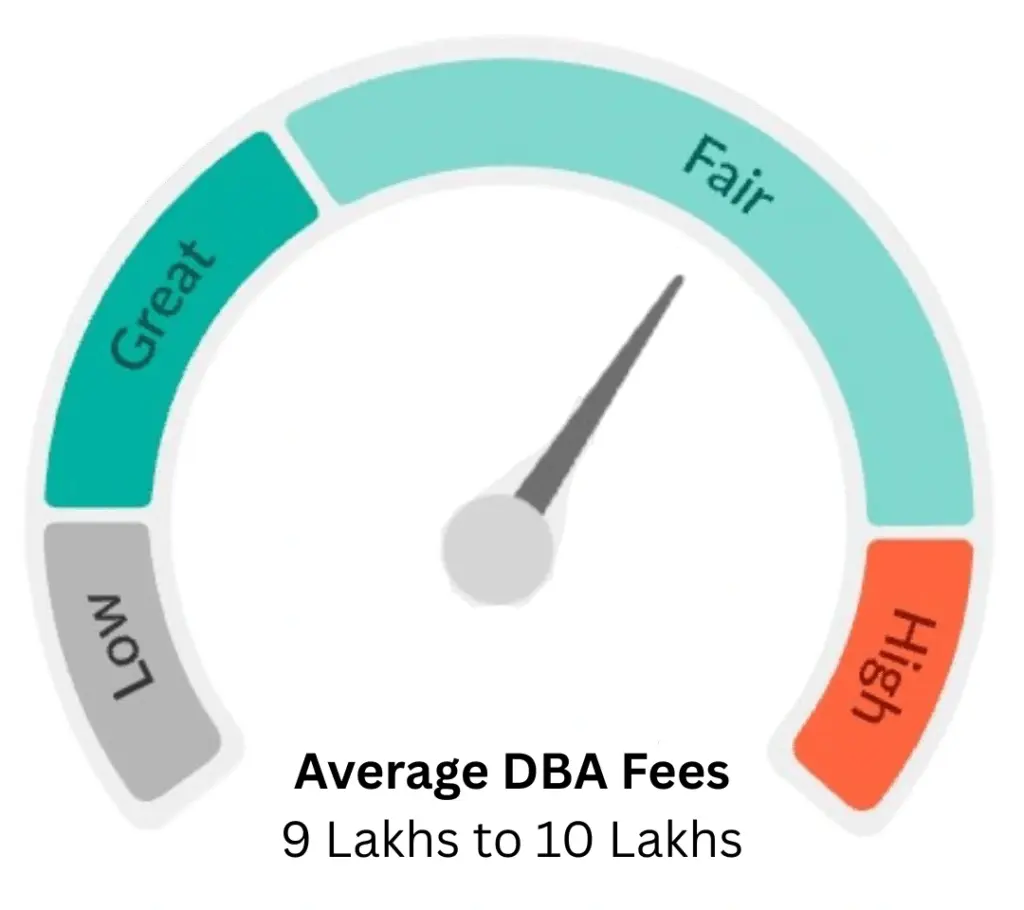
Price Guide
An online DBA program provides a flexible and affordable pathway to advanced doctoral-level business education.
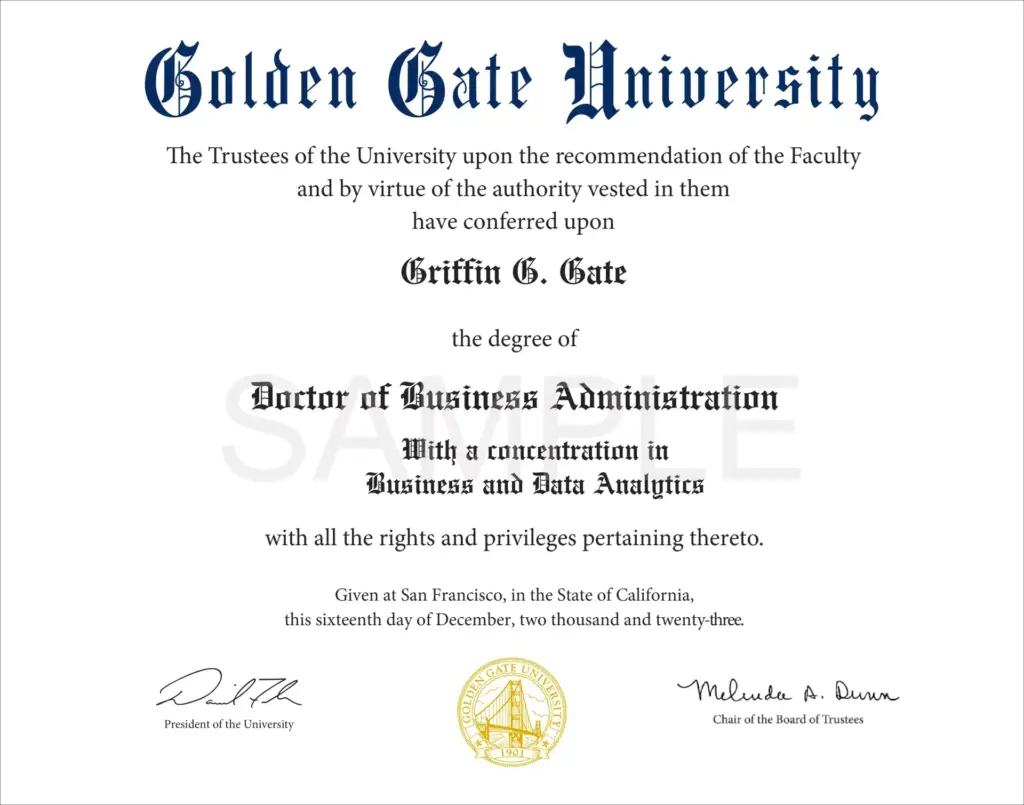
Earn a Globally Recognized Degree
Globally Recognized Degree
Earn a respected qualification that follows international academic standards and holds strong value across global job markets.
Career-Focused Education
Programs are designed to build hands-on, practical AI and decision-making skills that employers actively look for in leadership roles.
Strong Academic Credibility
Graduate with a degree supported by recognized accreditation, academic excellence, and industry relevance.
Government-Recognized NSDC Certification
Learners will receive an NSDC certification after program completion. This certification is nationally recognized, aligned with industry standards, and helps in improving employability and professional credibility.
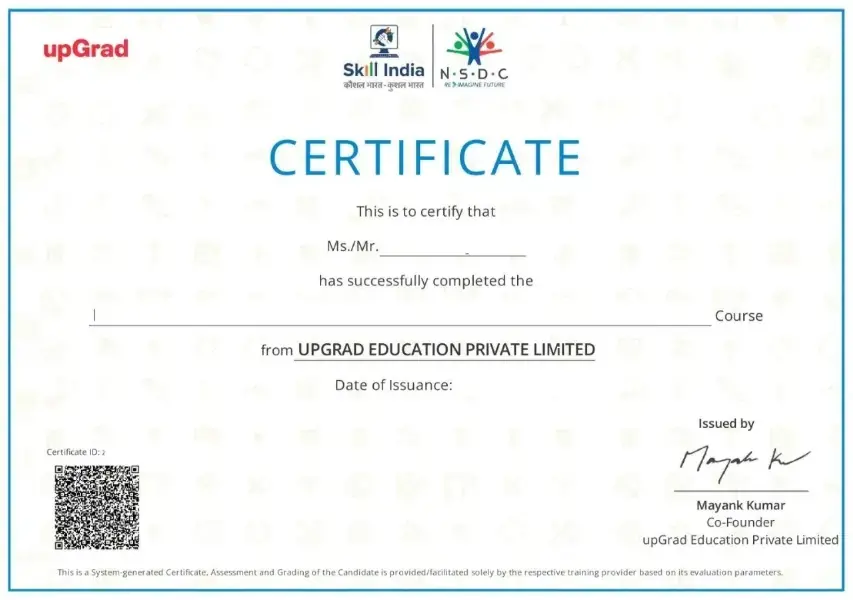
Upgrade Your Skills with Industry-Relevant Certifications
These Generative AI programs are designed to build practical, in-demand skills for modern industries, helping bridge the gap between education, technology, and employment.
Frequently Asked Questions
The DBA (Doctor of Business Administration) program is a doctoral-level qualification designed for experienced professionals who want to develop advanced leadership, research, and strategic decision-making skills for senior roles.
The DBA program is ideal for working professionals, executives, consultants, and business leaders who want to apply research directly to real-world business challenges rather than focusing only on academic theory.
Yes, the DBA program is offered in an online learning format, allowing professionals to balance their studies with work and personal commitments while accessing high-quality academic resources.
Graduates can pursue senior leadership roles, executive management positions, consulting careers, or academic and research-oriented roles in business schools and organizations worldwide.
Yes, the DBA degree is backed by recognized institutional accreditation, making it valuable for career advancement, professional credibility, and global employment opportunities.
Applicants typically need a master’s degree from a recognized institution along with relevant professional or managerial experience to be considered for the DBA program.
The duration of the DBA program generally ranges between three to four years, depending on the student’s pace, research progress, and dissertation requirements.
A DBA helps professionals strengthen leadership credibility, enhance strategic thinking, and apply advanced research skills to solve complex business problems, supporting long-term career growth.
Ready to Add Dr. title to your Name ?
Join thousands of learners already enrolled. Begin your journey towards a doctorate degree program today!